

They are off on the adventure of a lifetime! Read below for Mr King’s latest updates from the trip.
Monday 19 October
A big day today in terms of mileage, but with far less challenge than previous days’ trekking. We begin with a short climb out of Landruk through farmland, contouring the hillside above the Modi Khola valley. Spirits are high and energy good, despite a few of the team having succumbed to the usual traveller’s ailments, as well as an imported cold that has jumped from pupil to pupil throughout our two weeks.
We pass through Tolka, a small village a short way out of Landruk, and then begin a gradual climb through rhododendron forest up to the ridge. Scattered teahouses along a good trail lead us through Pitam Deurali, at around 2,000 metres, before we eventually reach Australian Camp and a final view of the stunning mountains, then descend to Kade and our road transfer back to Pokhara.
The students declared they had never felt such joy at the sight of a bus, and sank gratefully into its welcoming seats. And thus the trekking phase of the expedition was over.
We wound our way back down towards Pokhara, seeing signs of preparation for Dashain, the Hindu festival – a bit like Christmas. Most notable of these were piles of water buffalo meat and some very exciting-looking bamboo swings. Dashain, as our guide Leela – a font of knowledge about many things – explained, is a time when animals are sacrificed to appease the gods and ward off evil, so a lot of feasting goes on. The swings are for play and apparently aid digestion. Good to know.
It was great to be back at Butterfly Lodge: to shower, change, send some pretty revolting trekking gear to the laundry, and then head out into the bright lights of the town – really a city – for something more familiar than the dal bhat and its variations that we had become accustomed to on the trail.
Sunday 18 October
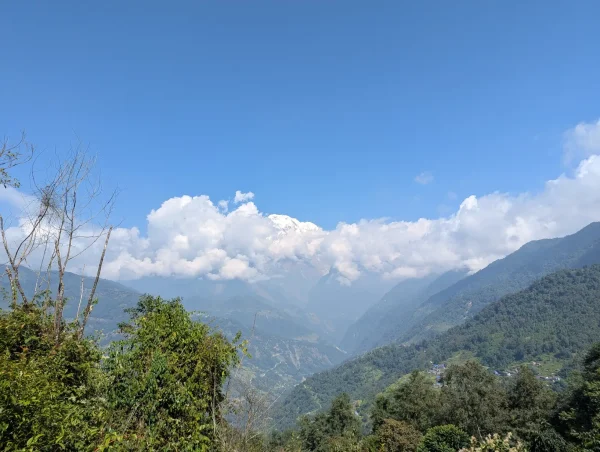
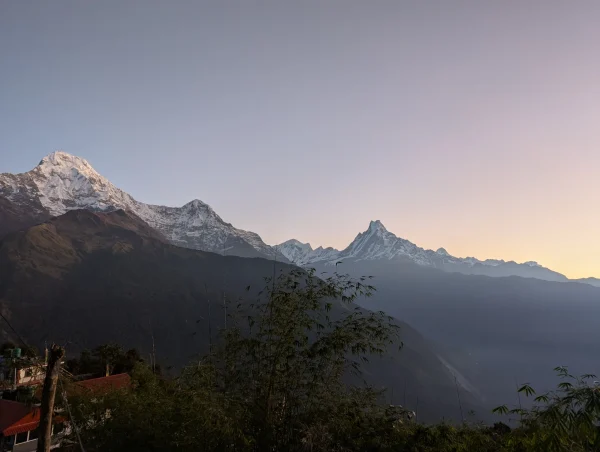
Despite the unfortunate combination of paper-thin walls and one of our French cohabitants snoring like a water buffalo all night, I woke at 5.30, peered through the window and saw the view. There was no way I could go back to sleep and miss the sunrise. I crept down the oddly backward-sloping wooden stairway that led from the upstairs corridor of dormitory rooms into the teahouse dining room, out onto the lawn, and watched as another breathtaking sunrise unfolded across the Annapurnas.
These trips contain moments that stay with you: moments of wonder, moments of hilarity, moments of intense stress and challenge, moments in which one sees significant change in the young people for whom we do this work. And sometimes there are moments for ourselves, solitary moments that we savour. This morning was one of mine.
It later transpired that a number of the students had enjoyed their own moment of wonder through their dormitory windows, and I was soon joined on the lawn by a few others. Afterwards, I headed in for my constitutional cup of tea, followed by coffee, followed by breakfast. Then we packed up and headed out from Hotel Magnificent, which had by now proved itself, in our eyes, worthy of its name.
As we began to descend through forests and terraced fields, the stunning views of Annapurna South, Hiunchuli and Fishtail dropped out of sight. We crossed a rickety bridge towards the Gurung village of Ghandruk, at roughly 1,950 metres. Ghandruk spans a huge section of the path, dropping over several hundred metres. Having made very good time, we stopped for lunch at a teahouse quite early, before embarking on the big descent down steep stone steps to the Modi Khola river.
We rallied at the foot of the last climb of the day, which would take us up to Landruk and what was promised to be a more comfortable guesthouse near the top of the village. Somewhat contentiously, the group began to split, with some of the team setting off at a good pace ahead of the rearguard. But, as in Aesop’s fable, the slow and steady group at the back soon caught up, and happily we reached our destination as a team, settling in for the night at the Peaceful Guest House.
Saturday 17 October
Through the paper-thin walls, somebody else’s alarm rang at the unspeakable hour of 3.45 am – a time for which no alarm should ever be set, and a good half hour before my own was due to rouse me from the middle of my sleep. No matter: when it’s that early, it hardly makes a difference. By 4.30 am the entire team had mustered outside the teahouse, packed light and ready for the trek up Poon Hill to witness the sunrise over the mountains.
It was a long, slow climb by head torch up steep steps to the summit. For the first half hour, it was fully dark, and a line of twinkling head torches bobbed and weaved, stretched out along the trail. As we puffed our way upwards, the air was noticeably thinner, and whenever we paused for breath, we’d be overtaken by another group – Spanish, French, British – only to overtake them again later. Everybody was headed for the same place.
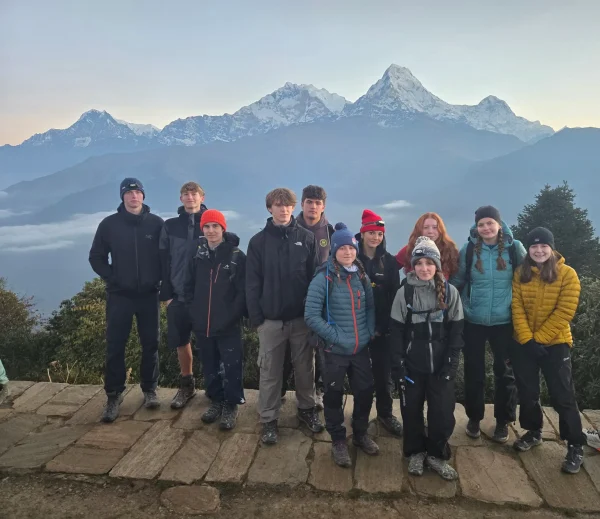
At last, we reached the Poon Hill summit, at 3,210 metres. A few other groups were already there, milling about, and a gentle buzz of anticipation hung in the pre-dawn air. By that time, the sky already had a soft pink tinge, the silhouettes of mountains lined the horizon from west to east, and a few lingering stars hung in the receding blue.
But first things first: I headed to the tiny tea shop. Surely this sunrise would be best enjoyed over a cuppa? I paid almost £1.50 for my morning brew – but did so gladly, upholding the English schoolteacher’s reputation for tea drinking.
As sunrise approached, more head torches trickled up the hill. I clanked up the cold iron steps of the viewing platform to join a small but growing throng waiting in hushed anticipation. Gradually, as the light changed, the sun caught the tip of Dhaulagiri to the west, and then Machhapuchhre, the sacred Fishtail Mountain, to the east. The snow lit up pink and orange, and bright rays beamed across in front of us, lighting up the mist. It was without doubt the most spectacular sunrise I’ve ever seen. Apart from a few celebratory whoops as the sun breached the horizon, a respectful quiet fell over the gathered crowd. With a conscious effort of will, I put my phone away and simply watched, soaking up the experience, the pupils equally in thrall.
To the north lay Annapurna South. It looked so close that it felt as if you could reach out and touch it. As we reflected later, in wanting to experience it and soak it all up, one really did want to be there on it and amongst it, to walk on those snowy slopes, breathe the icy air and embrace it all. It’s hard to articulate, but I think it was something we all felt in one way or another as we stood and watched the spectacle.
Still buzzing from the thrill of what we’d seen, we flew back down the steps to the teahouse for a hearty breakfast. The Tibetan bread was magnificent, served with the usual assortment of eggs, curry, pancakes and so on, all washed down with masala chai, Nescafé and hot chocolate. After packing up, we set off for Tadapani.
That day, we were to cover about 12 km over 10 hours, including the trek up to Poon Hill at 3,210 metres. The trek from Ghorepani began at 2,860 metres, and the trail took us east on a steady climb through rhododendron forest up to the ridgeline, eventually reaching Deurali a couple of hours later. Here, we were blessed with stunning views of the mountains and unusually clear weather that even saw the guides getting their cameras out to snap a few shots.
However, what characterised the day was the long descents: first dropping steeply down the side of a gorge, then following a stream bed through huge rhododendron forests that later gave way to bamboo. As the air warmed with our descent, the cicadas, crickets and butterflies made a reappearance. After some time, we reached Banthanti and our lunch stop, where we were treated to a procession of mules passing by the table, resplendent in their coloured tunics, their bells clanking evocatively as they went.
After a short climb through more forest – somewhat reminiscent of a Cornish wood, we all thought – we reached Hotel Magnificent in the village of Tadapani, at 2,630 metres. The weather had cooled, and cloud largely obscured the mountains; at this point, the hotel did not appear to warrant its name. However, I really liked this teahouse. A large central room had a furnace in the middle and windows along two sides, with wide, low, mattress-covered seating on one side of the table and relatively comfortable chairs on the other. It was a really good place to sit together as a group for the evening meal, reflections and the obligatory game of Mafia that finished the day.
Friday 16 October
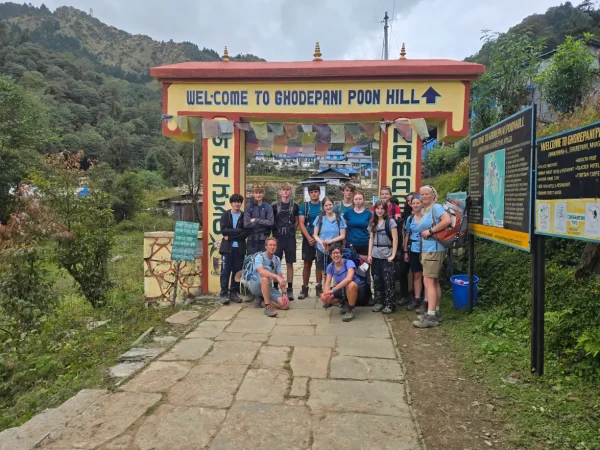
A big day today, with an early start – but not before the obligatory hearty breakfast. With bags packed and the boys, thankfully, now showered, we set off from Tikhedhunga in high spirits.
Today’s walk was a climb, and a steep one at that. Innumerable steps lined a route that was steadily and unambiguously uphill from the off. Over the course of the day, we climbed 1,400 metres in seven hours, and it was tough going at times. That’s the thing about the Himalayas: they offer all the uphill you could possibly ask for, and then some.
However, along the way, we were rewarded with magnificent views, amusing encounters with goats and mules, and plenty of refreshment breaks at beautiful little teahouses before reaching our lunch stop at Ulleri.
From Ulleri, the going was easier and the track wider, yet the climb continued, passing several shrines dedicated to those who had lost their lives in landslides. Our guide, Leela, talked about the enthusiasm with which new roads have been cut into the hillsides, while the reinforcement and engineering work that might have helped maintain them over time have been neglected, increasing the risk of landslides during heavy rain. All that soil ultimately ends up in the river in the valley below, raising water levels and causing flash floods as the water finds new routes downhill. We’ve spoken quite a lot about this, and although Leela is an upbeat and energetic guy, he can’t hide his sadness at the problems his country faces.
Anyway, ahead of schedule and to everybody’s great relief, we finally reached Upper Ghorepani.
Our guesthouse, Sunny Lodge, is the largest I’ve ever seen, with a dining hall on the top floor that I imagine will offer magnificent views when we sit down for breakfast tomorrow. This evening, everything was obscured by cloud, which brought with it a cold mist, necessitating the deployment of hats, gloves and down jackets all round.
A large furnace in the centre of the dining room provides wonderful warmth, which the bedrooms lack. The place is reminiscent of a remote Alpine ski lodge, minus the booming Europop, ski gear and bobble hats. It’s busy, too: many treks have been diverted to Poon Hill in light of recent conditions, and there’s always the draw of a dawn walk to the summit for views of magnificent 8,000-metre peaks – something we’re all very much looking forward to, though not, I might add, the 4 a.m. alarm.
Thursday 15 October
Today, we said goodbye to Pokhara and headed towards Birethanti and the start of our trek. We’d pared our kit down to the bare essentials, sharing one large rucksack between two, to be carried by the porters – or ‘boys’, as our guide, Leela, called them. These boys were ‘machines’. They would carry two of our rucksacks, as well as their own gear, and stride out ahead of us, reaching our destination hours before we sauntered in, exhausted, with our minimal day packs.
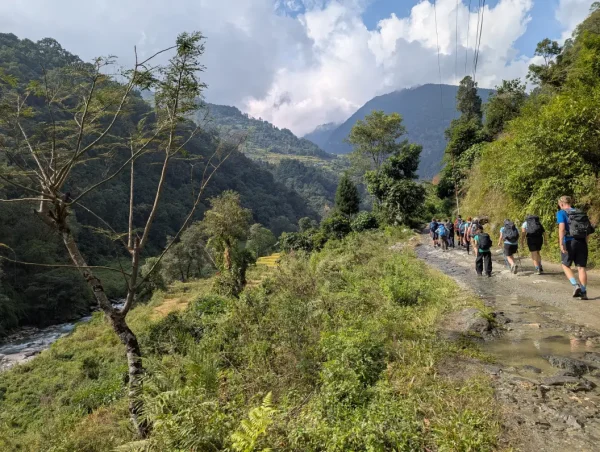
We set off from Birethanti, following the river valley and climbing steep stone steps, leaving the village behind as we ascended through lush forest filled with 30-foot bamboo, hanging vines, and incredible birds and butterflies. The group made steady progress, sticking together, walking at a sustainable pace and enjoying the scenery despite the heat. There was no grumbling. We stopped for water, shade and lunch in the village of Matathanti, which was very welcome.
We eventually reached the village of Tikhedhunga and the teahouse that would be our home for the evening, at an altitude of 1,540 metres. It was noticeably cooler.
The teahouse had a central stone courtyard, flanked on two sides by rooms spread over two floors, with a balcony above, hung with brightly coloured bulbs and overhanging vines. One side opened onto the trail as it wound its way through the village, with a little shop on the far side: a few rows of soft drinks and snacks displayed on rough wooden shelves. On the other side of the courtyard stood the kitchen block, from which came an assortment of sounds and tantalising wafts of whatever was being prepared. I watched with detached curiosity as a man split buffalo legs with an axe, from knee to hoof, before popping them into a fertiliser sack and carrying them into the kitchen.
Meanwhile, the students settled into their rooms whilst the staff enjoyed a masala chai in the courtyard. The girls showered and changed; the boys marinated and snacked. There was much excitement that evening as supper arrived: the boys had ordered steak, which emerged sizzling from the kitchen with great fanfare. Later, we whiled away the remaining hours playing games. It was great to see divisions breaking down, relationships being built, and everyone spending time away from their tech and in good company.
Wednesday 14 October
Small, brightly coloured songbirds foraged amongst the pot plants in the courtyard as I watched over a morning coffee, enjoying the cool air, the bright sunshine and a little peace and quiet before the group descended. A welcome moment of calm and contemplation.
Then, right on time, they trickled in, took their places and were soon tucking into a hearty Hotel Ganesh breakfast.
Soon after, bags packed, we trekked across town to meet our transport to the airport for our short flight to Pokhara, Nepal’s second city, gateway to the Annapurnas and home of Nepali trekking. The two-hour delay was expected. Nobody batted an eyelid, and we boarded the tiny aircraft for a 25-minute flight over incredible mountains and our first sight of some of the snowy peaks we would be amongst in the days ahead.
As we touched down in Pokhara, excitement began to build for what was to come and, for many of us, what we had really come here to experience. After a short bus ride across town, we checked into the Butterfly Lodge, with its comfortable rooms and hot showers.
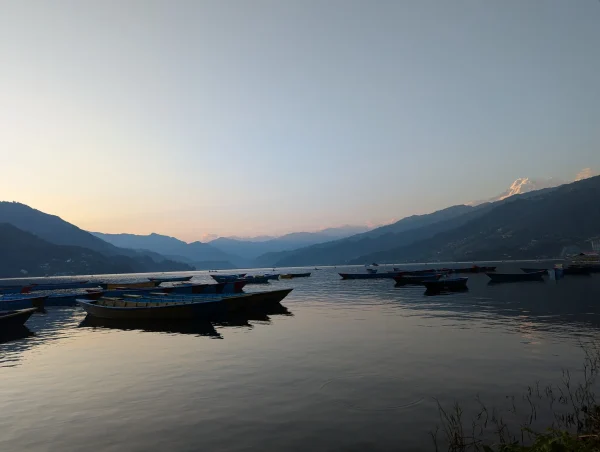
After orientation and some information about the trek from Leela, our guide, we walked down towards Pokhara’s famous lake, Phewa Tal. As we made our way through the bustling streets, very reminiscent of those in Kathmandu, I struggled to find anything I recognised from my previous visit 29 years ago. At that time, it was a small town with one dusty main street running along the lakeside, dotted with a few shops and cafés, a place where you could rent a rowing boat, and little else. In the years since, it has grown beyond all recognition.
I chatted to an old shopkeeper, who recounted stories from his childhood of walking from home to the lake to collect water, and sitting at his “school” for lessons under the sky. “So much change, so much change – everything change.” And so it is the world over, I suppose, but the pace of that change here is remarkable.
We ambled along for a while, enjoying the warm afternoon sun and the most incredible views of the soft, mist-coloured hills, spurs like theatre sets, and snow-covered mountains lit up beyond the flat expanse of the lake. We settled into a “hip” café with a large menu of food from around the world, including pizza, burgers and even fish and chips. We sank into chairs made of recycled tyres, which were surprisingly comfortable, though I was less keen on the rubbery odour they exuded. We sat and took in the stunning views through dappled sunlight and the shadows cast by swaying willows at the water’s edge.
The staff sensibly ordered some solid Nepali food and were rewarded with a delicious meal, whilst the pupils succumbed to their cravings for home, only to meet with some disappointment when soggy pizza and a curious take on fish and chips arrived.
After supper, we sat for the evening review to discuss our time on the project. As we went round the table, I was pleased to note increasingly thoughtful and reflective commentary from the pupils, which had definitely gone beyond the superficial and revealed more of their individual experiences, hopes and fears.
It’s hard to believe we’re only six days in, almost halfway, yet the change in the pupils is marked and hugely gratifying to observe, with arguably the most challenging but rewarding phase still to come. I look forward to seeing how the group responds to this next part of our journey.
Monday 12 and Tuesday 13 October
The day began with the now-familiar seven-kilometre hike to the work site. This was to be the team’s last opportunity to make a real difference to the school and its community, and the pupils were determined to make every moment count. During the previous evening’s reflection, a shared desire had emerged among the group: everyone wanted to feel that they had contributed something meaningful during their time in Bimiri. Their enthusiasm and commitment throughout the day certainly demonstrated just how seriously they had taken that ambition.
Eight hours later, the team stood in front of a freshly painted school, complete with new flower beds and a neatly cut-grass play area. Having worked hard to transform the surroundings in such a short space of time, they were delighted to present the small gifts they had brought with them for the teachers and children. It was genuinely touching to see how much the pupils’ efforts meant to both the school staff and the wider community. The warmth of their response made all the hard work worthwhile, and there was a real sense of pride, positivity and achievement as the team made their way back to the guest house for their final night in Bimiri. They had arrived only a few days earlier as visitors, but were leaving behind something tangible that they could feel proud of.
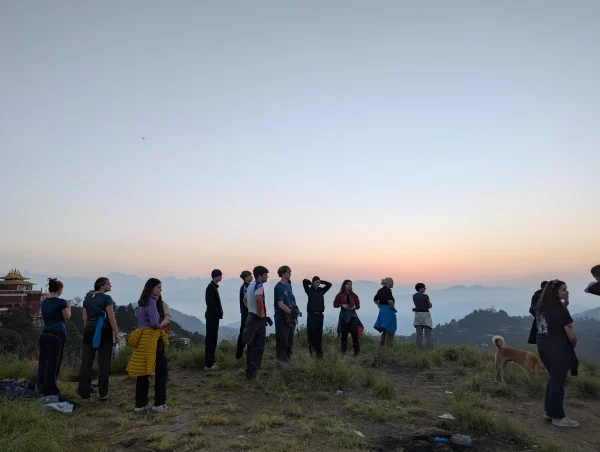
The following morning began very early, with the team up at 5am for a hike to Namo Buddha, one of Nepal’s most important Buddhist pilgrimage sites. The site is associated with a powerful legend about compassion and selflessness. According to the story, Prince Siddhartha encountered a hungry tigress in the forest who was too weak to feed her cubs. Moved by her plight, he offered his own flesh to save them. This extraordinary act of compassion is said to have set him on the path towards enlightenment.
Reaching the top in time for sunrise made the early start more than worthwhile. The team watched as the sun rose behind distant, snow-covered mountain peaks, hundreds of kilometres away, spreading soft pink and golden light across a valley filled with mist. It was an extraordinary sight and a moment of real tranquillity after several busy days of activity. For the pupils, it was an unforgettable experience and a fitting way to spend their final morning on the project — a chance to pause, reflect on what they had achieved and take in the remarkable landscape around them.
Afterwards, the team returned for the usual hearty Nepali breakfast: scrambled eggs, curried vegetables, the now-familiar sweet Nepali toast and sliced sausage. With the early start behind them, they enjoyed a little time to relax and appreciate the peace and quiet of the village before preparing to leave.
Later that morning, they took part in a cooking lesson, where they learned to prepare their own buffalo momos, a much-loved Nepali speciality that the group had developed something of a weakness for during their stay. There was plenty of enthusiasm for the task, and the freshly prepared momos would become their packed lunch for the journey back to Kathmandu — a final taste of Nepal’s wonderful food and hospitality before leaving the village behind.
After a somewhat emotional farewell to their hosts, the team began the long descent from Bimiri and made their way back towards Kathmandu. The transition was striking: after days surrounded by green hills, distant peaks and the peaceful sounds of the countryside, they soon found themselves back amid the noise, movement and energy of the capital.
Once checked in at the hotel, the group split up to embark on a series of shopping missions. The girls headed off in search of saris, while the boys focused on picking up kit and presents for their mums. It was a chance to explore more of Kathmandu, find a few souvenirs and bring home something to remember the expedition by.
The day, and their return to the capital, ended with a wonderful celebratory meal for Tess’s 18th birthday. Reaching such a milestone while travelling through Nepal, surrounded by friends and in the middle of such an extraordinary adventure, made it a birthday to remember. What a place to come of age.
Sunday 11 October
The team bade farewell to Kathmandu and set off for their project in the small village of Bimiri, around two hours’ drive from the capital. The first hour was spent making their way slowly out of the city through Kathmandu’s busy traffic, before the journey changed character completely. The second hour took them up narrow, winding mountain roads, gradually climbing into the hills towards the guest house where they would stay for the duration of their time on the project.
The Bimiri Foundation was established by Ian, an eccentric and well-travelled Scot who, inspired by the social media phenomenon of the Ice Bucket Challenge, set about working out how to bring fresh water to every home in the village. His determination to make a practical difference to rural communities has developed into an ambitious project, and working with World Challenge in recent years has helped accelerate the foundation’s progress towards its goals. The team is now supporting its work in its third village, helping to make a meaningful difference to communities in rural Nepal.
After arriving at the guest house and completing their orientation, the team set off on the six- or seven-kilometre hike to the village where they would be working. The walk took them through remote rural areas, away from the main roads and into communities where access to everyday facilities cannot be taken for granted. Some of these areas have no road access and are often without electricity or running water. The journey offered the team a valuable opportunity to see a different side of Nepal, experience the beauty of its rural landscape and gain a greater understanding of the challenges faced by some of its more remote communities.
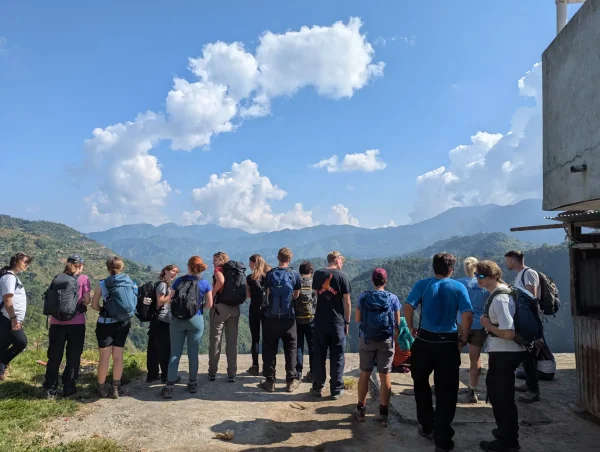
Eventually, they reached the school and wasted no time getting started. There was plenty to do to improve the school environment for the local children, and the team quickly divided their efforts across a range of practical tasks. Armed with small hand scythes, they set about cutting the grass, while others began building a small retaining wall for a flower bed. There were also windows to sand and paint, along with stonework that needed a fresh coat of paint. It was hands-on work that required teamwork, energy and a willingness to get stuck in, and the students embraced it wholeheartedly. Everyone threw themselves into the tasks, and in just a few hours the team had achieved an incredible amount, making visible progress in improving the school grounds.
By the time they began the walk back to the guest house, there was a real sense of accomplishment. The team had made a positive start to the project and were beginning to appreciate just how different life in rural Nepal could be from the busy streets of Kathmandu. The experience brought home the importance of the foundation’s work and gave the students a chance to see first-hand how practical improvements, however small they might seem, can make a difference to a local community.
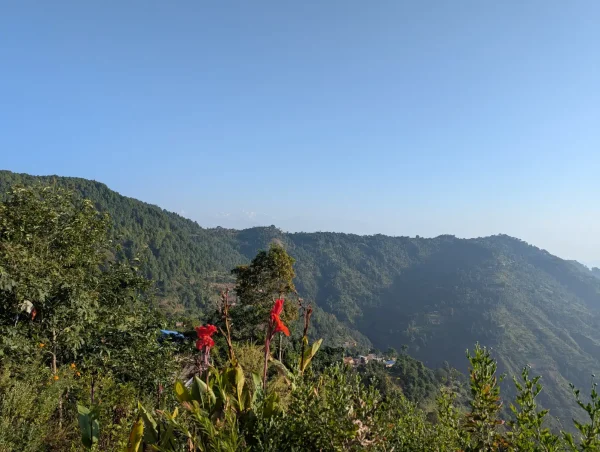
As they made their way back, the surroundings provided a spectacular contrast to the noise and energy of the capital. The bright lights, traffic and constant bustle of the city had been replaced by the peaceful sounds of the countryside, with only the chirrup and rattle of cicadas and crickets to provide the soundtrack. Verdant valleys stretched out below them, distant mountain peaks rose on the horizon, and the changing light transformed the landscape as the sun began to set. The team were treated to what must be one of the most spectacular sunsets on Earth — a breathtaking end to a busy, rewarding and memorable first day on the project.
Saturday 10 October
Everyone was grateful for a bit of a lie-in after an epic journey and a day spent immersing themselves in the hustle and bustle of Kathmandu’s lively Thamel district. Rested and refuelled by a hearty Nepali breakfast, the team set off on foot to visit the famous Monkey Temple, or Swayambhunath.
A steep climb up 365 steps brought them to the iconic white dome, topped by a golden spire and painted with Buddha’s all-seeing eyes. A sacred site shared by Hindu and Buddhist traditions, it offered the team a fascinating insight into Nepal’s rich spiritual and cultural heritage. Walking clockwise around the temple, they took in stunning views of the city and surrounding hills, spun the golden prayer wheels and enjoyed moments of tranquillity at one of Kathmandu’s most iconic landmarks.
Prayer flags fluttered in the afternoon sunshine beneath deep blue skies, prayer bells rang out and monkeys chattered noisily around the temple grounds, keeping everyone on their toes — and even managing to make off with Magnus’ water bottle!
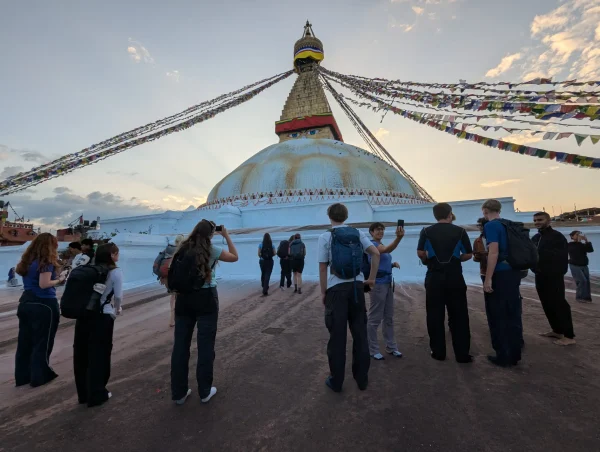
That evening, the team travelled across the city to Boudhanath, one of the largest stupas in the world and a major centre of Tibetan Buddhism. The atmosphere was captivating, with incense drifting on the breeze and monks in maroon robes chanting prayers, beating drums and playing the dungchen, a traditional Tibetan long horn with a deep, evocative sound.
Joining the steady stream of people slowly circling the stupa, the team witnessed the devotion of those making offerings and seeking blessings. It was a memorable opportunity to experience the living traditions of Nepal at the heart of its spiritual life.
An evening meal overlooking the stupa as the sun set rounded off an amazing second day, full of extraordinary sights, sounds and cultural experiences.
Friday 9 October
Two planes and a bus later, the team arrived in Kathmandu, where they were met by the World Challenge ground team. They then travelled by bus through the busy dawn streets on their way to Hotel Ganesh in Thamel.
After a brief orientation, the team grabbed 40 winks before reconvening to explore Kathmandu on foot.
Kathmandu was a real feast for the senses! The team experienced the energy and vibrancy of the city as bicycles, scooters, trucks, lorries, motorbikes and pedestrians all weaved their way through the narrow streets. The lively traffic and constant movement offered a fascinating first glimpse into daily life in Nepal, and the team soon found their feet as they made their way around the city.
The team took in the sights, smells and sounds of this ancient but thriving city. Later, they received a briefing from the organisation running the water project they will be helping with in the nearby village of Bimri. They then headed out to buy some supplies and gifts for the school.
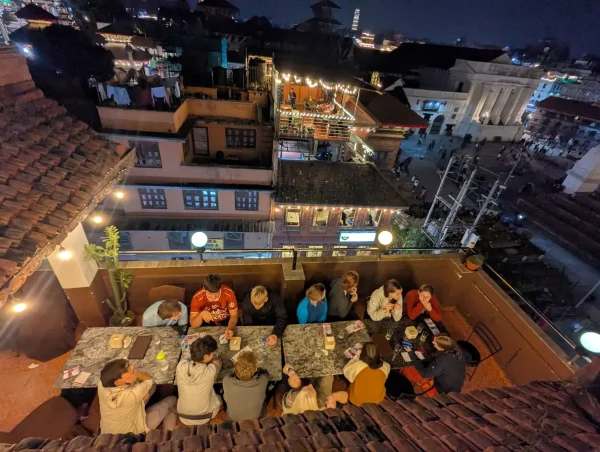
They rounded off the day with a fantastic evening meal at a rooftop restaurant overlooking Durbar Square. Once home to Nepal’s royal family, the square is now part of a UNESCO World Heritage Site. It also carries a poignant place in the country’s history, following the tragic events of the 2001 royal massacre.
It was a busy and memorable first day, giving the team a wonderful introduction to Kathmandu and the people and culture of Nepal!
Thursday 8 October
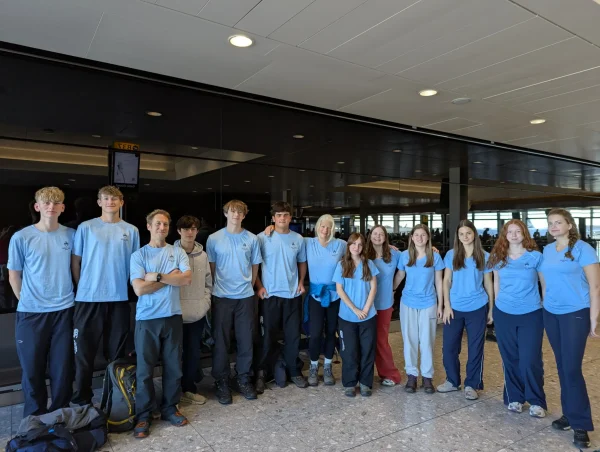
It was still fully dark at 6:00 a.m. as the Challengers assembled outside Main House, bags packed and ready for the off.
Just ten minutes later, the minibuses were on their way to Heathrow, and, apart from the usual traffic on the approach to Terminal 2, the journey went very smoothly.
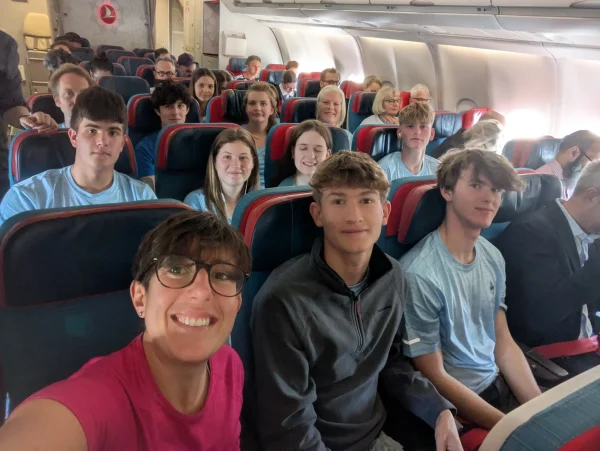
There was the usual excitement and a few last-minute checks along the way, but everyone arrived at Heathrow safely and in good spirits. After successfully navigating check-in and security, the team is now ready for the next leg of the journey: Heathrow to Istanbul.
Spirits are high, the adventure is underway, and the team is looking forward to what lies ahead!
Here’s what they’ll be getting up to while they’re away
| 9th Oct | Arrival |
| 10th Oct | Orientation in Kathmandu |
| 11th Oct | Bimini Community Initiative |
| 12th Oct | Bimini Community Initiative |
| 13th Oct | Bimini Community Initiative |
| 14th Oct | Travel to Pokhara |
| 15th Oct | Poon Hill Trek Day 1 |
| 16th Oct | Poon Hill Trek Day 2 |
| 17th Oct | Poon Hill Trek Day 3 |
| 18th Oct | Poon Hill Trek Day 4 |
| 19th Oct | Poon Hill Trek Day 5 |
| 20th Oct | Explore Pokhara |
| 21st Oct | Travel back to Kathmandu |
| 22nd Oct | Departure back home! |